Menu
In progressAssignment 01 — Kickoff & Ideation
Case Study · 09

Trace

HEALTH PLATFORM · UX · PRODUCT DESIGN
Year2026
TypeHealthcare Platform
RoleUX · Product · Research
DurationOngoing
HERO IMAGE — Upload in right panel
THE BRIEF
THE CHALLENGE

In Ireland, there is a significant disconnect between healthcare providers when it comes to patient medical history. The current system relies entirely on the patient to verbally communicate their history during appointments. People forget medications, conditions, procedures. Connections between symptoms go unnoticed.

THE GOAL

Design Trace — a personal health record platform that gives patients full ownership of their medical history. Bridging the gap between Ireland's fragmented public and private healthcare systems, and making the invisible visible.

THE PROBLEM

The doctor who knows the least about your health is often sitting in front of you.

In Ireland, there is a significant disconnect between healthcare providers when it comes to patient medical history. The current system relies almost entirely on the patient to verbally communicate their history during appointments.

People forget medications they have been on, conditions they have been treated for, or procedures they have had done. This leads to gaps in care that could easily be avoided.

The person who knows the least about your health history is often the doctor sitting in front of you.

Scans stuck in departments

A scan done in one hospital cannot be accessed by a specialist in the same building without calls, emails and delays.

History recalled from memory

Patients relay their full history on the spot. They forget things. Connections between symptoms go unnoticed.

Insurance discovered too late

Coverage is only visible after the fact. Receipts get lost. Claims fall short. Patients never knew what they were entitled to.

Family history is a blind spot

Hereditary conditions go unrecorded. Doctors ask. Patients guess. Critical clinical patterns remain invisible.

PERSONAL EXPERIENCE

Why this project started with me.

Trace is not an abstract brief. It came from four real moments where the Irish healthcare system failed to share information it already had. These are personal.

01
Year-long waiting list

GP referral to endocrinologist — 14 months between referral and first appointment. No tracking, no updates, no visibility into where I was in the queue.

02
Scan inaccessible

Ovarian scan done in the same hospital. Two different departments. Still required multiple phone calls to transfer a file that already existed on their system.

03
€300 appointment, wrong information

Gave incorrect family history during a private specialist appointment because the information simply was not available to me in the moment.

04
Insurance shortfall

Submitted claims after the appointment. Covered for less than expected. Would have upgraded the plan if coverage had been visible before the appointment.

These four moments are not edge cases. They are the standard experience for a privately insured patient navigating Ireland's public-private healthcare split.

COMPETITIVE RESEARCH

What already exists, and why Trace sits in the gap.

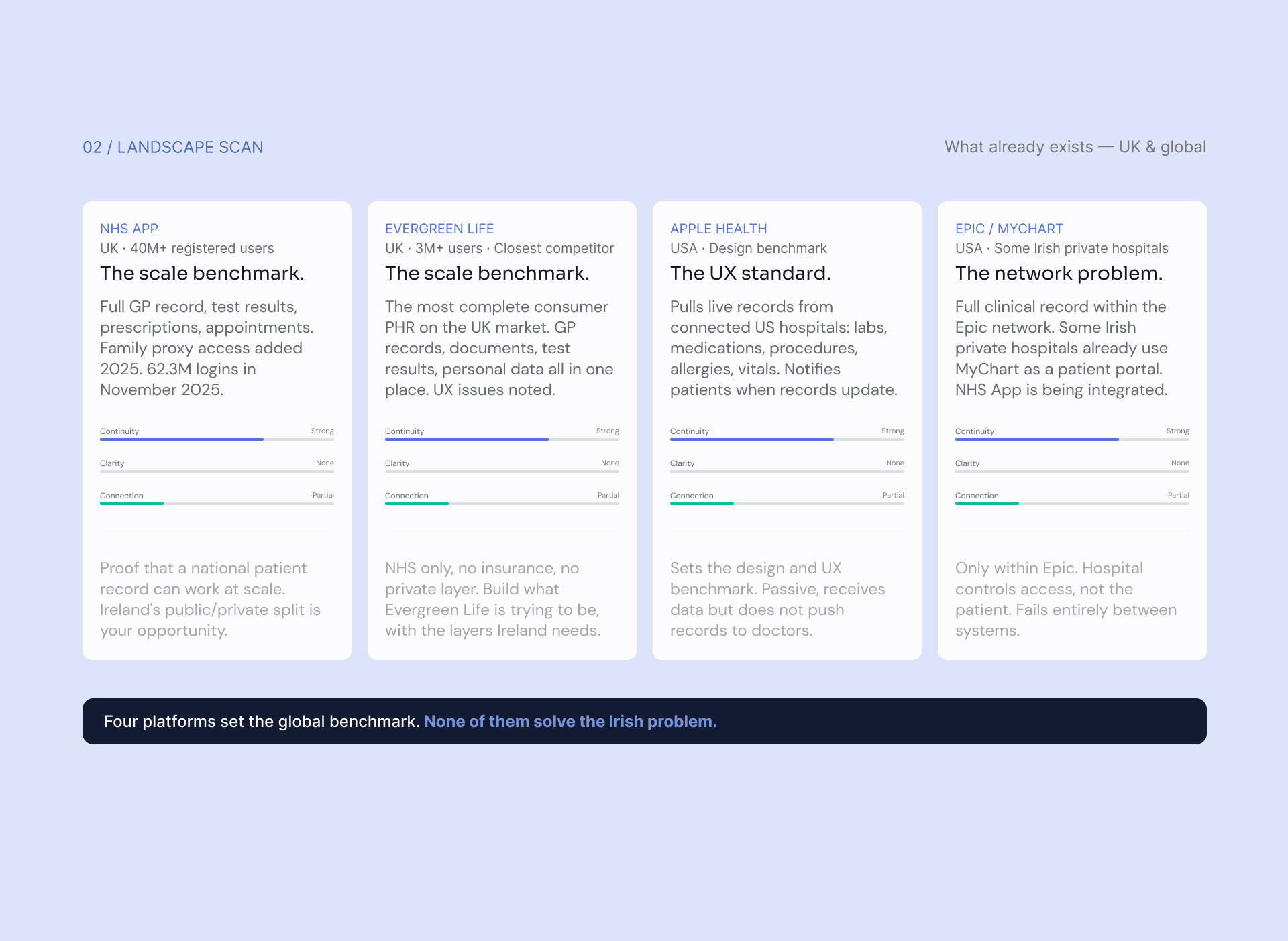
Analysis of four direct and adjacent competitors across Ireland and internationally. The pattern is consistent: existing products are either too narrow, too siloed, or too dependent on provider infrastructure the Irish system cannot offer.

Ireland — Public
HSEapp

Ireland's first patient-facing digital health product. Vaccination records, maternity appointments. From Sept 2025, appointment tracking across 31 hospitals.

Scale — national deployment, 900K+ patients

Built from the public side inward. Will never bridge the public-private divide.

Trace sits precisely in the gap it cannot fill.

Ireland — Private Insurance
VHI/Laya Apps

Claims submission, policy checker, online GP, symptom checker. Wellness rewards. Entirely outside the patient health journey.

Partial UX clarity on claims

No pre-appointment coverage visibility. No connection to the health record.

A significant pain point with no current solution.

UK — Consumer PHR
Evergreen Life

Most complete consumer PHR on the UK market. GP records, documents, test results, personal data in one place.

Breadth of record — the benchmark for completeness

NHS only. No insurance layer. No private healthcare integration.

Build what Evergreen Life is trying to be, with the layers Ireland needs.

Global — Consumer
Apple Health

Pulls live records from connected hospitals. Labs, medications, procedures, allergies, vitals. Sets the design and UX benchmark.

Design standard — the UX benchmark globally

Passive — receives data but cannot push records. US-centric hospital integrations.

Sets the experience bar. Trace should aspire to this quality.

DESIGN PRINCIPLES

What Trace believes.

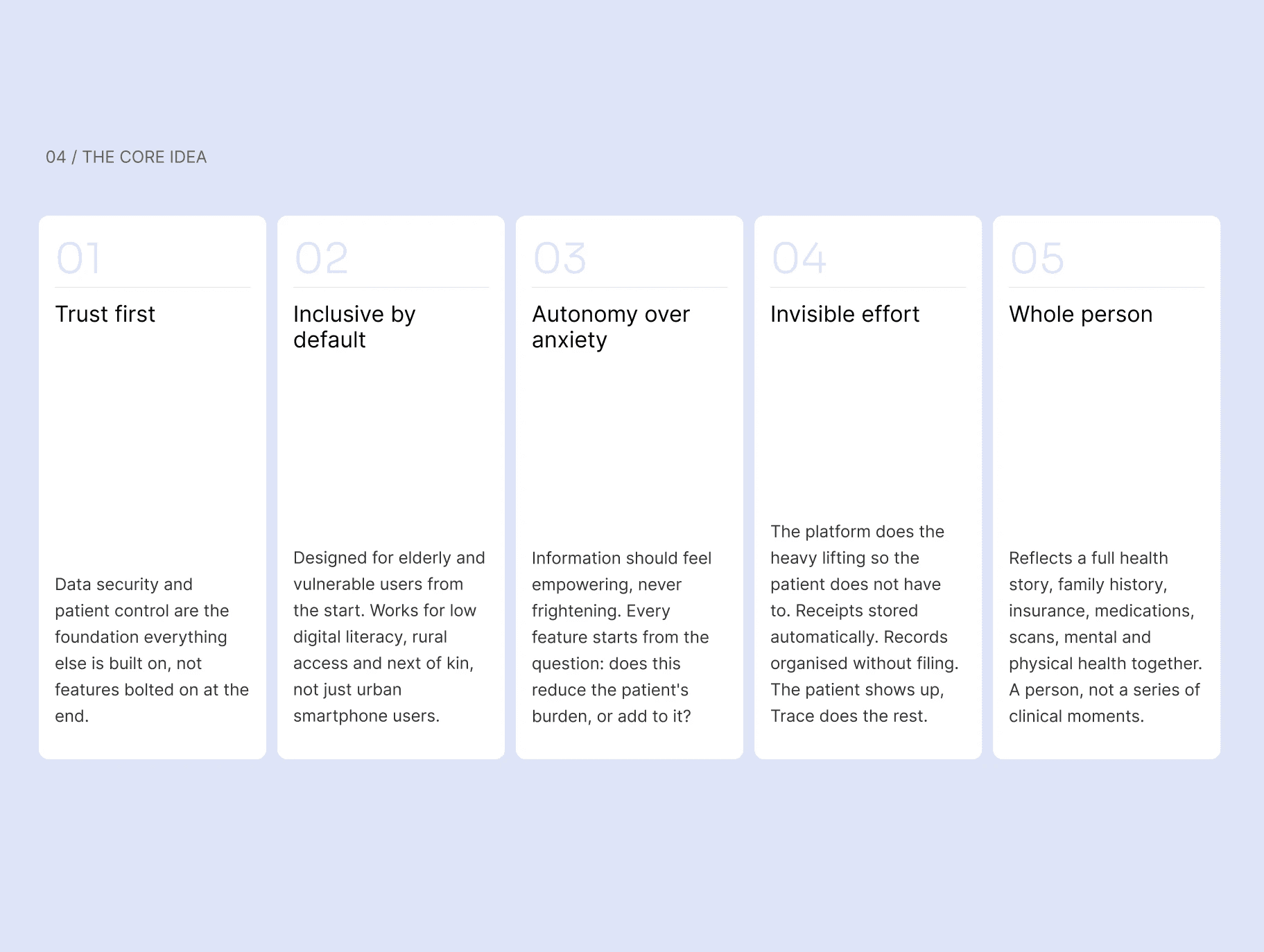
Five principles that govern every design decision in this project. They are not aspirational — they are constraints. If a feature violates them, the feature changes.

01
Trust first

Data security and patient control are the foundation everything else is built on, not features bolted on at the end.

02
Inclusive by default

Designed for elderly and vulnerable users from the start. Works for low digital literacy, rural access and next of kin, not just urban smartphone users.

03
Autonomy over anxiety

Information should feel empowering, never frightening. Every feature starts from the question: does this reduce the patient's burden, or add to it?

04
Invisible effort

The platform does the heavy lifting so the patient does not have to. Receipts stored automatically. Records organised without filing. The patient shows up, Trace does the rest.

05
Whole person

Reflects a full health story — family history, insurance, medications, scans, mental and physical health together. A person, not a series of clinical moments.

DESIGN OPPORTUNITY
THE OPPORTUNITY

Every tool exists in isolation. None of them talk to each other. Trace is the layer that connects them — giving patients a single place where their complete health story lives, across public and private, regardless of which system generated it.

HOW MIGHT WE...

How might we give patients a complete view of their own health history — across all providers — without requiring those providers to change their systems?

How might we make insurance coverage visible before the appointment rather than after?

How might we ensure that patients are never the weakest link in their own healthcare?

How might we design for low digital literacy and elderly users without compromising on power for those who want it?

How might we build a product that stores sensitive health data in a way patients genuinely trust?

How might we connect the public-private divide in Irish healthcare that no government system will close?

THREE PILLARS
Continuity
Your full record, everywhere you go. No gaps, no repetition.
Clarity
What you have, what you're covered for, what comes next.
Connection
Bridging public and private, GP and specialist, today and history.
BRAND IDENTITY + MOODBOARD

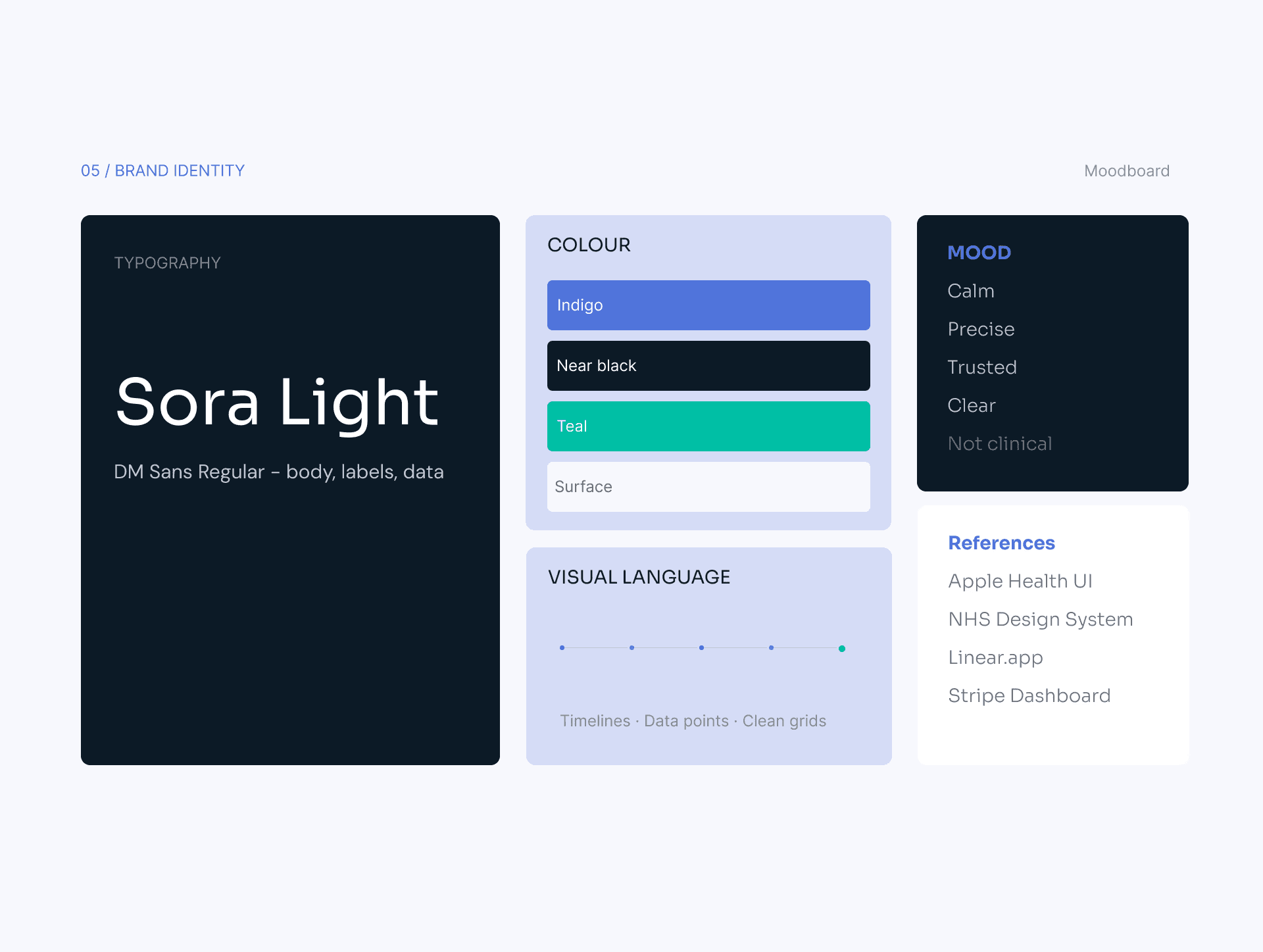
Calm, precise, trusted.

The visual identity for Trace is still evolving, but the direction is clear. It needs to feel medical without feeling clinical. Trustworthy without feeling corporate. The palette and references below are the starting point for Assignment 2.

MOOD
Calm
Precise
Trusted
Clear
Not clinical
COLOUR DIRECTION
Brand Blue
rgb(80, 116, 220)
Light Lavender
rgb(221, 227, 249)
Off White
rgb(245, 247, 255)
Deep Ink
rgb(26, 28, 46)
VISUAL REFERENCES
Apple Health UI
NHS Design System
Linear.app
Stripe Dashboard
WHAT COMES NEXT

Assignment 2 will focus on user research, persona development, and beginning the information architecture for the core Trace record view. The visual identity will be formalised as part of that assignment.

back to all projects

Get in touch

Let's work together

I'm always open to a good project - or just a good chat

Aoife Randles - Portfolio 2026Back to top